
Why Belgium still thinks too individually about collective heat
The energy transition is well underway. Gas has to go, CO₂ has to come down, and homes need to be heated more sustainably. But if you look at how we are tackling this in Belgium, one thing stands out: we are trying to solve a collective problem with individual solutions. And that is where the friction lies.

From gas to… thousands of individual decisions
Even today, a large share of Belgian households still heat with fossil fuels. Natural gas dominates in Flanders, while heating oil remains firmly rooted in Wallonia. According to recent Eurostat figures, roughly 40 to 45 percent of Belgian households heat with natural gas, and taken together fossil fuels remain by far the main energy source for space heating.
At the same time, more than 70 percent of residential energy consumption goes to heating. That makes Belgium one of the worst performers in Europe.
And while emissions from buildings have declined slightly in recent years, it is not self-evident to attribute that entirely to structural decarbonisation. Better insulation certainly plays a role, but milder winters also temporarily reduce energy demand (source: klimaat.be). That makes the progress less robust than it may seem at first glance.

If we want to meet the climate targets towards 2050, it will not be enough to keep doing what we are doing today. The logical reflex is to look for an alternative to fossil fuels.
The dominant choice seems to be to electrify heating through individual heat pumps. That choice is also actively supported by policy, such as that of the Flemish government, with subsidies and renovation requirements that steer households towards electric solutions.
On paper, the story adds up. Electric heating can, especially as the electricity grid becomes greener, significantly reduce emissions. It also reduces direct dependence on fossil fuels.
But in practice, the story is less clear-cut.
The reality of the individual heat pump
The heat pump is often presented as the solution for sustainable heating. In reality, it is a technology that works well in the right context, but is far from straightforward everywhere.
For many households, the barrier to entry remains high. The upfront investment quickly reaches tens of thousands of euros, even after taking subsidies and tax benefits into account. On top of that, a heat pump rarely stands on its own. To work efficiently, it requires a well-insulated home, often combined with low-temperature heating and, in many cases, solar panels.
There is also the fact that the economic logic is not always compelling. Although recent policy measures and the geopolitical context are narrowing the gap between gas and electricity, electricity in Belgium is still noticeably more expensive than natural gas. Analyses show that the price ratio is improving, but not yet to the point where heat pumps are automatically cost-effective for every type of home.`

There are practical caveats as well. In densely built areas, outdoor units can sometimes cause noise nuisance, and not every home has the space to integrate an installation easily. Maintenance and repairs can also be more expensive than for conventional heating systems.
The result is that the heat pump is mainly a good solution for those who are technically and financially ready for it. For a large part of the housing stock, it remains challenging.
Policy pushes, but also makes it harder
At the same time, the policy landscape is changing. Where support measures in recent years were meant to accelerate the shift to sustainable technologies, we now see certain incentives being phased out.
The Flemish government is, among other things, limiting access to renovation grants for certain income groups and abolishing a number of specific subsidies.
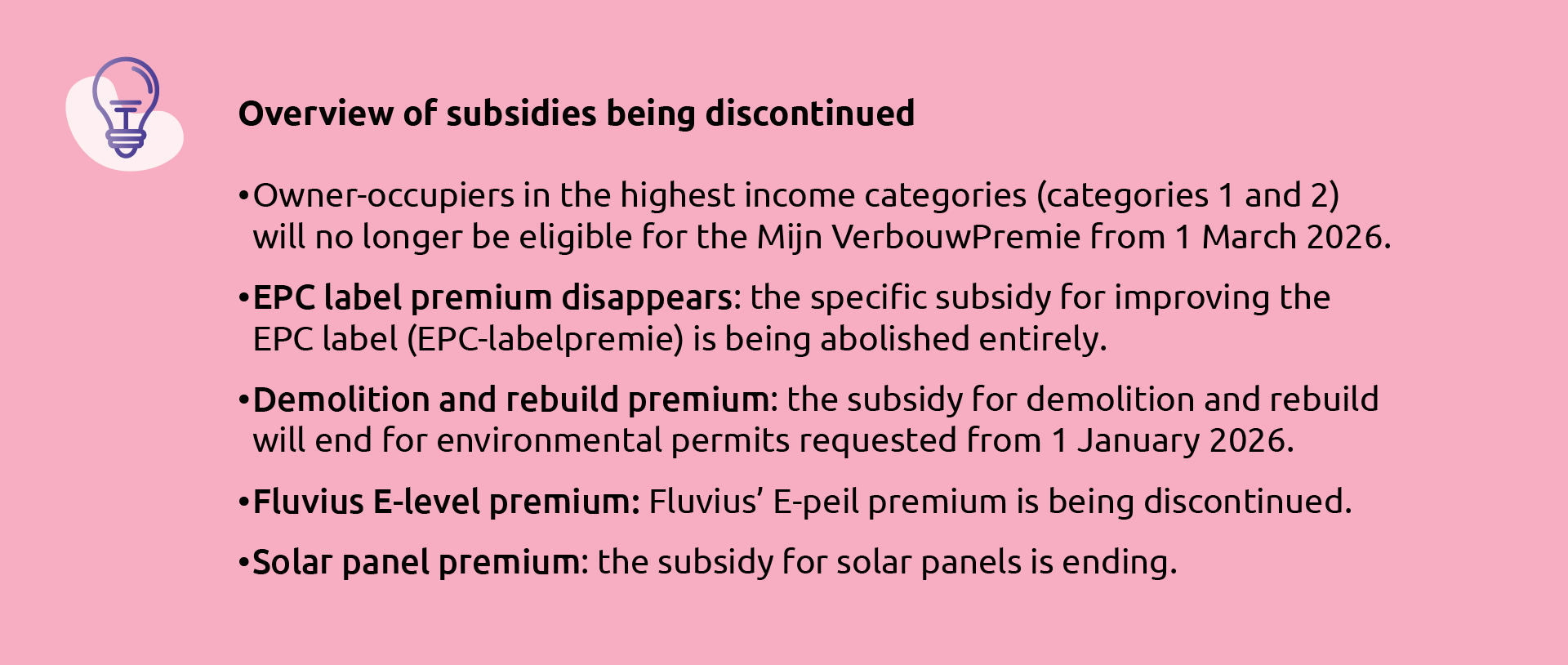
That raises the financial threshold again, precisely at the moment when large-scale investments are needed.
That combination of high costs and reduced support adds further pressure to the idea that individual households have to carry the transition themselves.
Electrification is not automatically carbon-free
There is a deeper tension in the narrative. Electrification is often equated with sustainability, but that is not automatically the case.
Belgium’s electricity mix is not yet fully carbon-free. Fossil fuels still play a role in electricity generation (source: Federal Public Service Economy). That means electrification shifts part of the problem, rather than eliminating it entirely.
That effect will decrease as the grid continues to decarbonise, but in the short term it remains an important nuance.
An individual reflex for a collective problem
Put all of these elements together and a striking pattern emerges. Heating is by far the largest energy consumer in homes, and fossil fuels still dominate. At the same time, policy and practice put the emphasis on individual solutions.
So we are asking millions of households, each on their own, to make major investments, make technical choices, and deliver their own piece of the energy transition.
All of this leads to an uncomfortable question:
Is this really the most efficient way to decarbonise an entire society?
The challenge we face is not individual. It is about infrastructure, scale, and system choices. And that is exactly where a fragmented approach runs into its own limits.
Collective heat: the forgotten story
If the challenge is collective, why do we not treat it that way too?
In countries such as Denmark, collective heat has been the norm for decades. Large parts of cities are connected to district heating networks, where heat is produced centrally and distributed efficiently. That creates systems that are not only more sustainable, but also more resilient and more scalable.
In Belgium, that logic is still the exception rather than the rule.
Yet collective solutions offer clear advantages. By creating scale, heat sources that would otherwise be wasted can be used, such as residual heat from industry or data centres. A collective approach also makes it possible to combine different technologies and deploy them flexibly, depending on availability and cost.
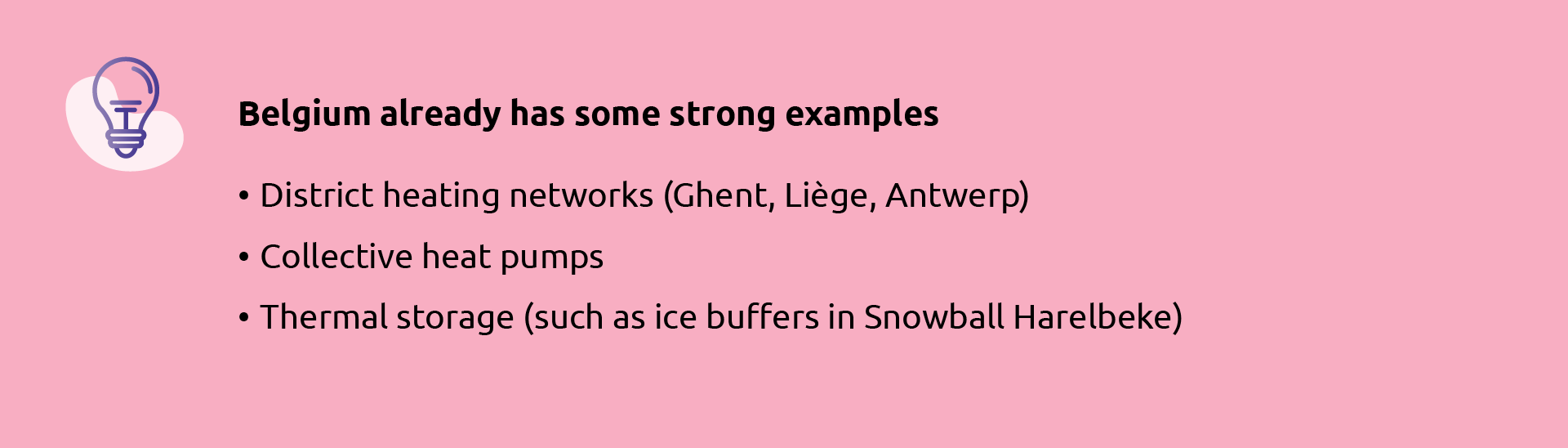
For end users, that lowers the barrier significantly. Instead of having to make large investments themselves, households can connect to existing infrastructure. That makes the energy transition not only more efficient, but also more inclusive.
There are infrastructure benefits too. Where mass electrification can heavily burden the electricity grid, collective systems make it possible to steer demand and supply more effectively, and to store and distribute energy more intelligently.
Why do we invest massively at the individual level?
The question is not only technical, but also cultural and political. Belgium has historically had a highly fragmented energy and housing market, with a strong focus on individual ownership. That also shows up in policy and regulation, which are often better aligned with individual solutions than with collective infrastructure.
But that leads to a paradox:
We subsidise thousands of individual systems… while collective solutions are often more efficient in the long run.
Collective projects require a different way of thinking. They require coordination between many stakeholders, including governments, grid operators, project developers, and energy suppliers, and they require investment over a longer time horizon.
That makes them more complex to initiate, but no less logical at the system level.
The missing middle: hybrid and collective models
The future is unlikely to be a single solution. Not every home must or can be connected to a district heating network, and not every situation lends itself to a collective approach.
But today, the middle ground is often missing.
A future-proof energy system combines different solutions depending on context. Individual heat pumps where they make sense, collective systems where economies of scale matter, and smart combinations of both.
Think of neighbourhoods with collective heat pumps, connected to local heat networks and complemented by thermal storage. Or dense urban areas that make maximum use of residual heat, while less dense areas invest in individual solutions.
It is not either-or. It is both-and.
From a technology choice to a system choice
The heating debate is too often reduced to a choice between technologies: heat pump or boiler, gas or electricity.
But that is not the right question.
The real question is how we organise our energy system. Do we choose a model where every home optimises its own solution? Or do we build a system that achieves efficiency and sustainability at a larger scale?
As long as we keep thinking in terms of individual optimisation, we risk suboptimal outcomes at the system level.
Time to take collective heat seriously
The heat pump is not the problem. But the idea that every home must have its own solution deserves a critical look.
If Belgium wants to meet its climate targets, it will have to look beyond individual technologies alone. Collective heat is not a miracle cure, but it is an essential part of the answer.
So the question is not whether collective systems have a role to play.
The question is when we start taking them seriously, and how quickly we shift from individual reflexes to systems thinking.
You might also like...
ERP vs Utility Billing Software: What's the difference?
Can an ERP system handle utility billing? Short answer: Yes. But most ERP systems were not designed specifically for utility billing. Enterprise Resource Planning (ERP) software such as Microsoft Dynamics, SAP, Oracle, Unit4 and NetSuite is built to manage core business functions including finance, procurement, HR and asset management.

District heating billing software: Should you build or buy?
As heat networks grow, managing consumption data, billing, and customer interactions becomes critical. Many heat network operators still rely on Excel, but spreadsheets quickly become inefficient as networks expand. Errors, slow invoicing, and poor customer visibility limit growth and compliance.

Peppol e-invoicing: what is it, who is it for, and how does Zero Friction make it super easy-breezy?
Digitalization in the energy world is moving at lightning speed. More and more heat suppliers are switching to e-invoicing via Peppol. But… what exactly is Peppol? And how do we make sure you hardly need to worry about it? In this blog, we'll explain it simply. 😉
Stay tuned
Subscribe to our newsletter and get quarterly updated on market news, our new customers, product updates and much more!
