
District heating billing software: Should you build or buy?
As heat networks grow, managing consumption data, billing, and customer interactions becomes critical. Many heat network operators still rely on Excel, but spreadsheets quickly become inefficient as networks expand. Errors, slow invoicing, and poor customer visibility limit growth and compliance.

Why Excel Fails for Heat Network Management
• High risk of manual errors
• Complex billing and cost allocation
• Poor customer portfolio visibility
• Difficulty handling move-ins/outs and complaints
• Not scalable for growing networks
• Limited transparency for customers
For growing heat and cooling suppliers, investing in specialized software is essential.
Making vs Buying Software
The initial question when seeking an alternative solution is: 'Do I want to develop the software internally or buy from an external party?' All options have their pros and cons, which we'll explore.
In-house development: Customizable and fully controlled, but costly, slow, and requires specialized billing knowledge. Also finding the right developers can be a challenge, and you will need continuous investment to keep your solution up-to-date and comply with changing regulations.
Buy and ERP Software: Provides broad functionality, but often expensive, hard to customize, and not niche-focused. On the other hand, no developers are needed and ERP Softwares often have long term contracts.
SaaS Solutions: The best of both worlds: affordable, scalable, quick to implement, and tailored for the heating and cooling sector. Benefits include:
• Lower upfront and predictable subscription costs
• Rapid deployment and faster billing cycles
• Scalable for network growth
• Cloud access for remote work
• Automatic updates and regulatory compliance
• Market-focused for utilities and heat networks
Example: HeatPlus
Imagine a heat supplier named 'HeatPlus' with around 1000 heat connections, aiming to rapidly expand its heating network to 15,000 connections.
Currently managing their back-office and front office using Excel, they encounter limitations such as:
• difficulty in overseeing their customer portfolio
• time-consuming monthly and yearly invoicing,
• challenges in handling customer queries and complaints.
They face significant challenges in managing data from their renewable energy installations. Manual processes for customer management and billing resulted in a high 20% error rate in billing accuracy and delayed billing cycles by an average of 15 days. These issues straine resources and impact customer satisfaction adversely.
Option 1: Build own billing system
• Find the right IT developers (expensive): HeatPlus would need to hire a team of skilled developers or outsource this to an agency, which is costly.
• Spend a lot of time scoping the needs, testing, validating: The development process could take a year or more with no guaranteed results.
• Customer Portal: Developing a customer portal would be an additional task.
Estimated Cost: €300.000 (Basic version, spending a year without guaranteed results)
Option 2: Buy ERP software

• Buy a software license: Investing in an ERP software license can be very costly upfront, requiring a significant financial investment.
• Set up the project with customization: Adapting the software to meet specific needs and requirements.
• Customer Portal: A custom portal is an additional task
• Annual maintenance: You’ll need to make extra costs over time to maintain the software en keep it up-to-date.
Estimated Cost: €350.000 (Initial investment, without maintenance costs, further updates and yearly licence costs)
Option 3: Outcome with Zero Friction's SaaS Solution
Predictable monthly costs, automatic updates, GDPR compliance, billing errors <1%, 50% faster billing, 30% higher customer satisfaction.
HeatPlus achieved:
• Billing errors reduced to <1%
• Billing cycles shortened by 50%
• Enhanced operational efficiency, improved cash flow, and 30% increase in customer satisfaction
Estimated Cost: Purpose-built for district heating. Includes one-time implementation fee, predictable monthly subscription (based on users and connections), optional add-ons. All plans include Azure storage, continuous upgrades, GDPR and ISO 27001 compliance, multi-organization setup, local legislation compliance, and 24/7 support.
Zero Friction optimized HeatPlus's processes and positioned them as a leader in sustainable heating solutions, enabling effective scaling and growth.
Want to be successfull as HeatPlus? Check out the Zero Friction website for more information.
You might also like...
ERP vs Utility Billing Software: What's the difference?
Can an ERP system handle utility billing? Short answer: Yes. But most ERP systems were not designed specifically for utility billing. Enterprise Resource Planning (ERP) software such as Microsoft Dynamics, SAP, Oracle, Unit4 and NetSuite is built to manage core business functions including finance, procurement, HR and asset management.

Why Belgium still thinks too individually about collective heat
The energy transition is well underway. Gas has to go, CO₂ has to come down, and homes need to be heated more sustainably. But if you look at how we are tackling this in Belgium, one thing stands out: we are trying to solve a collective problem with individual solutions. And that is where the friction lies.
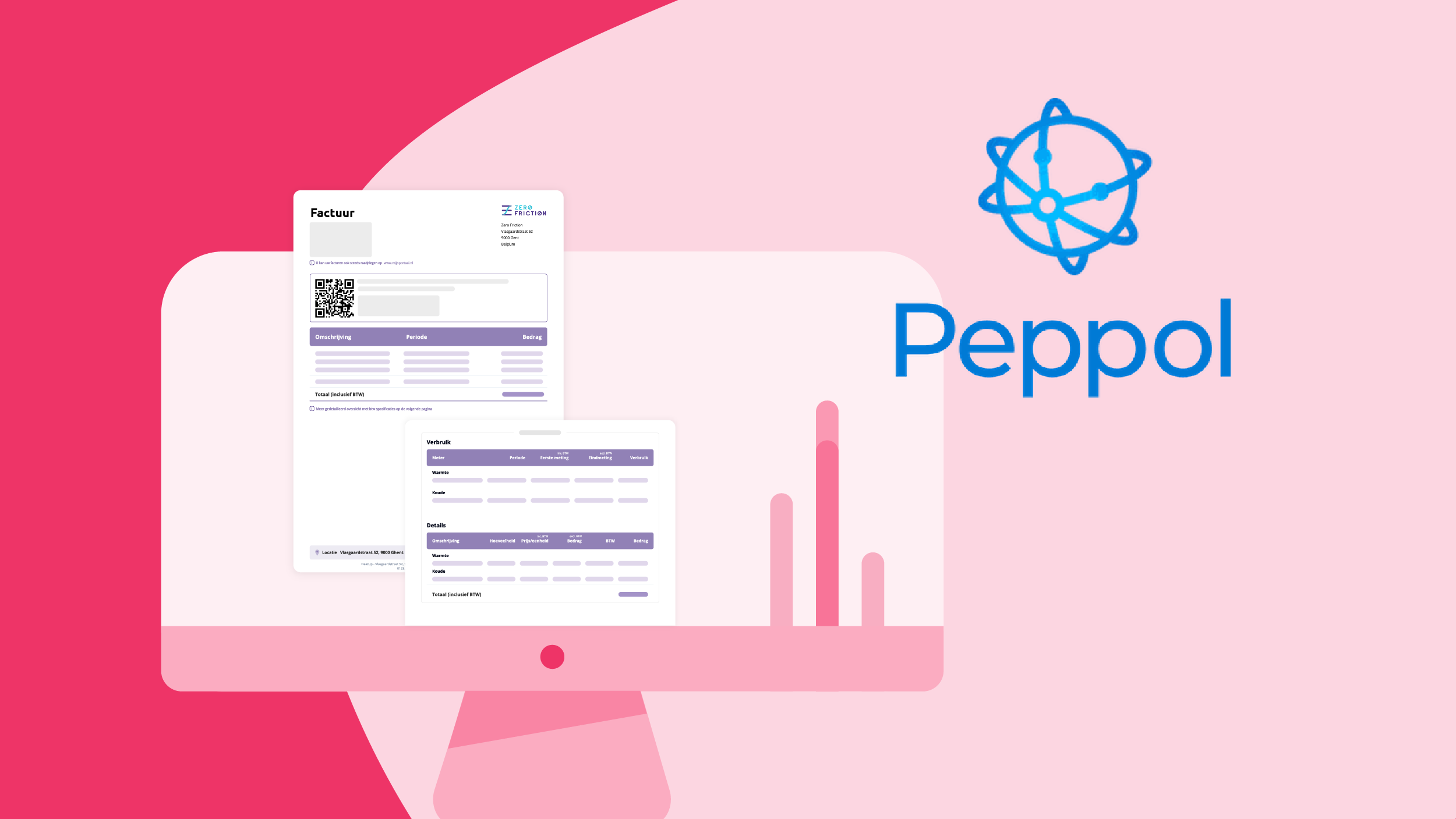
Peppol e-invoicing: what is it, who is it for, and how does Zero Friction make it super easy-breezy?
Digitalization in the energy world is moving at lightning speed. More and more heat suppliers are switching to e-invoicing via Peppol. But… what exactly is Peppol? And how do we make sure you hardly need to worry about it? In this blog, we'll explain it simply. 😉
Stay tuned
Subscribe to our newsletter and get quarterly updated on market news, our new customers, product updates and much more!
