
Peppol e-invoicing: what is it, who is it for, and how does Zero Friction make it super easy-breezy?
Digitalization in the energy world is moving at lightning speed. More and more heat suppliers are switching to e-invoicing via Peppol. But… what exactly is Peppol? And how do we make sure you hardly need to worry about it? In this blog, we'll explain it simply. 😉
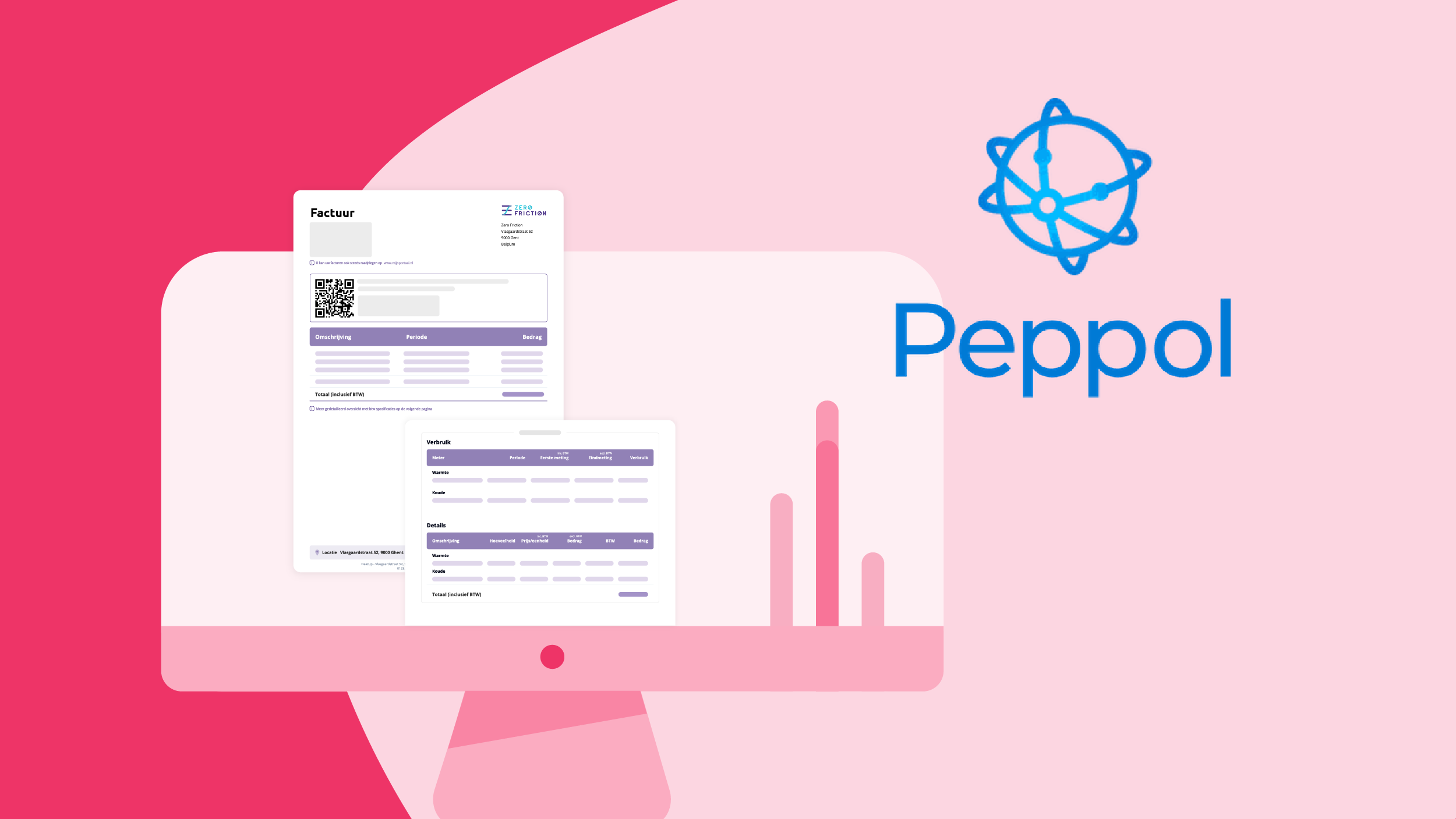
What is Peppol?
Peppol stands for Pan-European Public Procurement Online. It's a secure, international network through which companies and governments exchange electronic documents, especially invoices.
Instead of sending PDFs via email (which can get lost, be processed incorrectly, or require manual input), Peppol provides structured, digital communication via one standard, fast, reliable, and 100% traceable.
Who is Peppol intended for?
Peppol is primarily used by:
• Government institutions: already mandatory in many countries.
• B2B companies: more and more organizations are switching to automate their administration.
• Heat and energy suppliers: like you, where invoice volumes are high and accuracy is crucial.
💡 Important for Belgium: from 2026, electronic B2B invoicing will be mandatory. Invoices must then be exchanged in a structured format. Peppol is the standard on which that obligation is based.
How does Peppol work technically? (UBL in brief)
Peppol uses standardized file formats so that invoices can be processed automatically and error-free.
The most important standard is:
🔧 UBL – Universal Business Language
UBL is a structured XML format that contains all important invoice information, such as:
- invoice date
- amounts
- VAT specifications
- product details
- payment information
Where a PDF is a "picture" of an invoice, a UBL file is data that your system directly understands.
How Peppol and UBL work together
1. You create an invoice in Zero Friction
2. Zero Friction automatically generates a UBL invoice according to Peppol specifications
3. This is automatically sent via a certified Peppol Access Point
4. The recipient receives the invoice in their system, automatically processed, without manual copying
5. Both parties can track the sending and receipt thanks to Peppol's traceability
➡️ The result: no errors, no manual processing, everything 100% standardized.
Why Peppol?
The advantages are clear:
✓ Automatic delivery in the correct format
✓ Higher payment certainty
✓ Fewer errors through standardization
✓ Traceability on every sent invoice
✓ Future-proof
- More and more countries are mandating e-invoicing
- In Belgium, B2B e-invoicing is mandatory from 2026
The Zero Friction integration: Friction Fighters at work ⚡️
With our new Peppol integration, we make e-invoicing super simple for heat suppliers.
What does it bring you?
✨ Send invoices automatically via Peppol directly from Zero Friction
✨ No more manual exports or uploads
✨ Traceability in the communication overview
✨ Quick to get started without complex configuration
✨ Fully ready for the Belgian requirement of 2026
With one click, you send invoices via the Peppol network, fully integrated into your familiar Zero Friction environment.
E-invoicing via Peppol is fast, secure, uniform, and ready for the future. Thanks to our integration, digital invoicing for your organization becomes not only easier but also frictionless.
You might also like...

How do you set up customer management for a heat network?
Connecting a heat network is one thing. Giving residents the feeling that they are in control of their energy is another. And that is precisely where heat networks often fall short: the technology is in place and the network supplies heat, but the customer management behind it is often treated as the final piece rather than the starting point.

French e-invoicing compliance for heat networks: What changes in 2026 and how to prepare
France is introducing one of Europe's most ambitious electronic invoicing programmes. From September 2026 onwards, companies will gradually be required to exchange invoices electronically and report transaction data directly to the French tax authorities.
ERP vs Utility Billing Software: What's the difference?
Can an ERP system handle utility billing? Short answer: Yes. But most ERP systems were not designed specifically for utility billing. Enterprise Resource Planning (ERP) software such as Microsoft Dynamics, SAP, Oracle, Unit4 and NetSuite is built to manage core business functions including finance, procurement, HR and asset management.
Stay tuned
Subscribe to our newsletter and get quarterly updated on market news, our new customers, product updates and much more!
