
French e-invoicing compliance for heat networks: What changes in 2026 and how to prepare
France is introducing one of Europe's most ambitious electronic invoicing programmes. From September 2026 onwards, companies will gradually be required to exchange invoices electronically and report transaction data directly to the French tax authorities.

For heat networks, district heating operators and utility providers, this means that traditional PDF invoices and email-based processes will no longer be sufficient for many B2B transactions.
This article explains what is changing, what heat suppliers need to do, and how Zero Friction helps organisations become compliant without disrupting existing billing operations.
What is changing?
The French government is introducing mandatory electronic invoicing (e-invoicing) and e-reporting for VAT-registered businesses.
The objectives are:
✔️ Reduce VAT fraud
✔️ Improve tax transparency
✔️ Simplify invoice processing
✔️ Accelerate digitalisation across French businesses
Under the new framework, invoices must be exchanged through approved platforms and transaction data must be shared with the French tax administration.
French e-invoicing timeline
From 1 September 2026
All businesses must be able to receive electronic invoices.
Large companies and medium-sized enterprises (ETIs) must also start issuing compliant electronic invoices.
From 1 September 2027
The obligation to issue electronic invoices extends to small businesses and micro-enterprises.
By this date, virtually all VAT-registered businesses in France will be affected.
Will France enforce penalties immediately?
While the legal deadlines remain unchanged, French tax authorities have publicly indicated a pragmatic onboarding approach. Organisations that can demonstrate genuine implementation efforts are unlikely to face automatic penalties from day one.
However, this should not be interpreted as a delay of the reform. Companies are still expected to be connected to a compliant platform and actively preparing for mandatory e-invoicing by September 2026.
What does this mean for heat networks?
Heat suppliers and district heating operators typically process thousands of invoices every year for:
⮕ Property managers
⮕ Housing associations
⮕ Commercial customers
⮕ Municipal organisations
⮕ Industrial customers
These invoices will need to comply with French e-invoicing requirements whenever they fall within the scope of the regulation.
In practice, this means organisations must ensure that their billing software can:
• Generate compliant electronic invoices
• Exchange invoices through approved channels
• Support required invoice formats
• Manage reporting obligations towards the French authorities
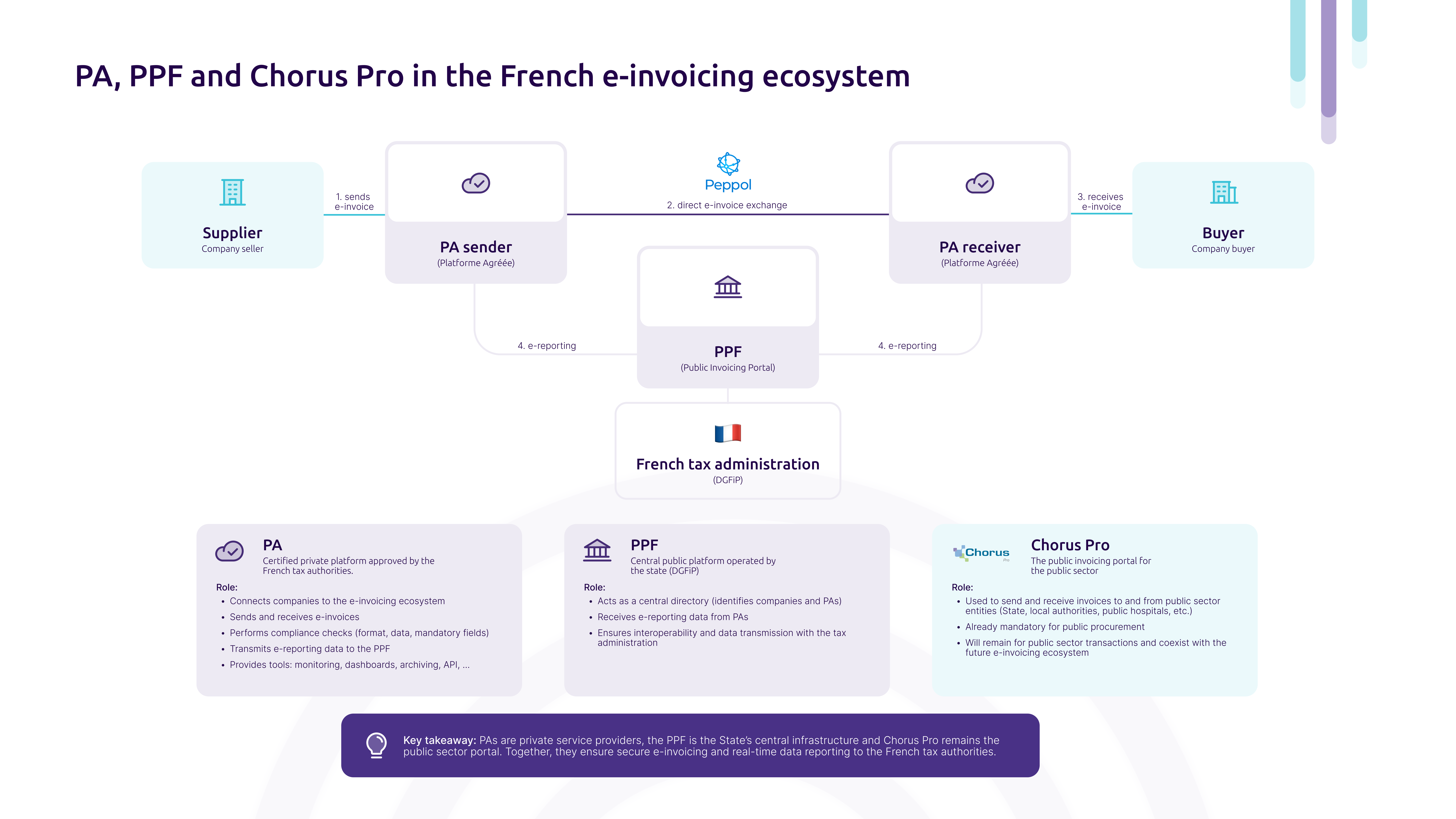
Understanding PA, PPF and Chorus Pro
Many organisations are confused by the different platforms involved.
PA (Platforme Agréée)
A PA is a certified platform authorised to exchange electronic invoices and communicate with the French tax administration.
Most businesses will connect to the French ecosystem through a PA.
PPF (Public Invoicing Portal)
The Public Invoicing Portal acts as part of the national infrastructure supporting the French e-invoicing framework.
Chorus Pro
Chorus Pro is already widely used for invoicing public sector entities in France and remains an important component within the broader French digital invoicing landscape.
Which invoice formats are accepted?
France supports several structured invoice formats, including:
• Factur-X
• UBL
• CII
These formats allow invoice data to be processed automatically rather than being treated as simple PDF documents.
How Zero Friction supports French e-invoicing
Zero Friction billing software is able to
✔️ Generate French-compliant electronic invoices in UBL format
✔️ Exchange invoices through a certified PA
✔️ Simplify compliance with French e-invoicing requirements
Moreover, Zero Friction is preparing customers for French compliance through a combination of integrations:
Peppol-ready electronic invoicing and PA integration
Every invoice generated in Zero Friction is already available as a structured electronic invoice in UBL format, aligned with the Peppol BIS invoicing guidelines.
Because invoices are created in a structured format rather than as standalone PDF documents, they can be processed automatically by accounting systems, ERP platforms and other digital invoicing solutions. This reduces manual data entry, improves processing efficiency and supports broader digitalisation initiatives.
To support the French e-invoicing framework, Zero Friction is integrating with Arratech, a certified Plateforme Agréée (PA). This enables organisations to exchange compliant electronic invoices through the French e-invoicing ecosystem without changing their existing billing processes.
For users, the process remains simple. B2B invoices can be sent using a straightforward Send action within Zero Friction. Behind the scenes, Zero Friction transmits the structured electronic invoice through the PA integration to the recipient, while supporting the requirements of the French e-invoicing framework.
For organisations that already exchange electronic invoices through Peppol, the impact of the French reform is expected to be relatively limited. The underlying invoice structure remains largely unchanged, meaning compliance can typically be achieved through configuration and connectivity updates rather than large-scale redevelopment projects.
Chorus Pro support
Zero Friction already supports organisations that need to interact with the French public invoicing ecosystem through a native Chorus Pro integration.
Invoices B2G are automatically uploaded from the Zero Friction Platform to the Chorus Pro platform.
Why heat networks should prepare now
Although the first deadlines start in September 2026, waiting until the final months before implementation introduces unnecessary risk.
Heat suppliers should already be evaluating:
• Their invoicing software
• Peppol readiness
• Chorus Pro requirements
• Reporting obligations
• Customer onboarding processes
Organisations that start preparing early will avoid rushed implementation projects and reduce compliance risks.
Can heat suppliers wait until 2027?
The answer is usually no. Even though many smaller organisations will not be required to send e-invoices until 2027, everyone must be able to receive electronic invoices from September 2026. This means that the technical preparations must be in place by 2026.
Future-proof your billing operations
French e-invoicing is more than a regulatory requirement. It is part of a broader digital transformation of utility billing and financial processes.
Zero Friction helps heat suppliers, district heating operators and utility providers stay compliant while maintaining efficient and scalable billing operations.
If your organisation is preparing for French e-invoicing, talk to our team about how Zero Friction can support your compliance journey.
You might also like...

How do you set up customer management for a heat network?
Connecting a heat network is one thing. Giving residents the feeling that they are in control of their energy is another. And that is precisely where heat networks often fall short: the technology is in place and the network supplies heat, but the customer management behind it is often treated as the final piece rather than the starting point.
HNTAS explained: What technical assurance means in practice
As the UK heat network sector matures, technical assurance is becoming a central part of delivering reliable, efficient, and customer-focused heat networks. One of the key initiatives shaping this evolution is Heat Network Technical Assurance Scheme, better known as HNTAS. But what does technical assurance actually mean in practice for heat network operators? And how does it impact day-to-day operations beyond engineering and infrastructure?

Is your heat network ready for Ofgem regulation? A practical compliance checklist
The UK heat network market is entering a new era of regulation. With Ofgem set to become the regulator for heat networks, operators are facing increasing pressure to improve transparency, customer protection, operational processes, and data quality. For many organisations, the challenge is no longer *whether* regulation is coming, but whether their network is operationally ready for it. At the same time, frameworks such as Heat Network Technical Assurance Scheme (HNTAS) are raising the bar for technical and operational standards across the industry. So what should heat network operators focus on today to prepare for tomorrow’s regulatory environment?
Stay tuned
Subscribe to our newsletter and get quarterly updated on market news, our new customers, product updates and much more!
